
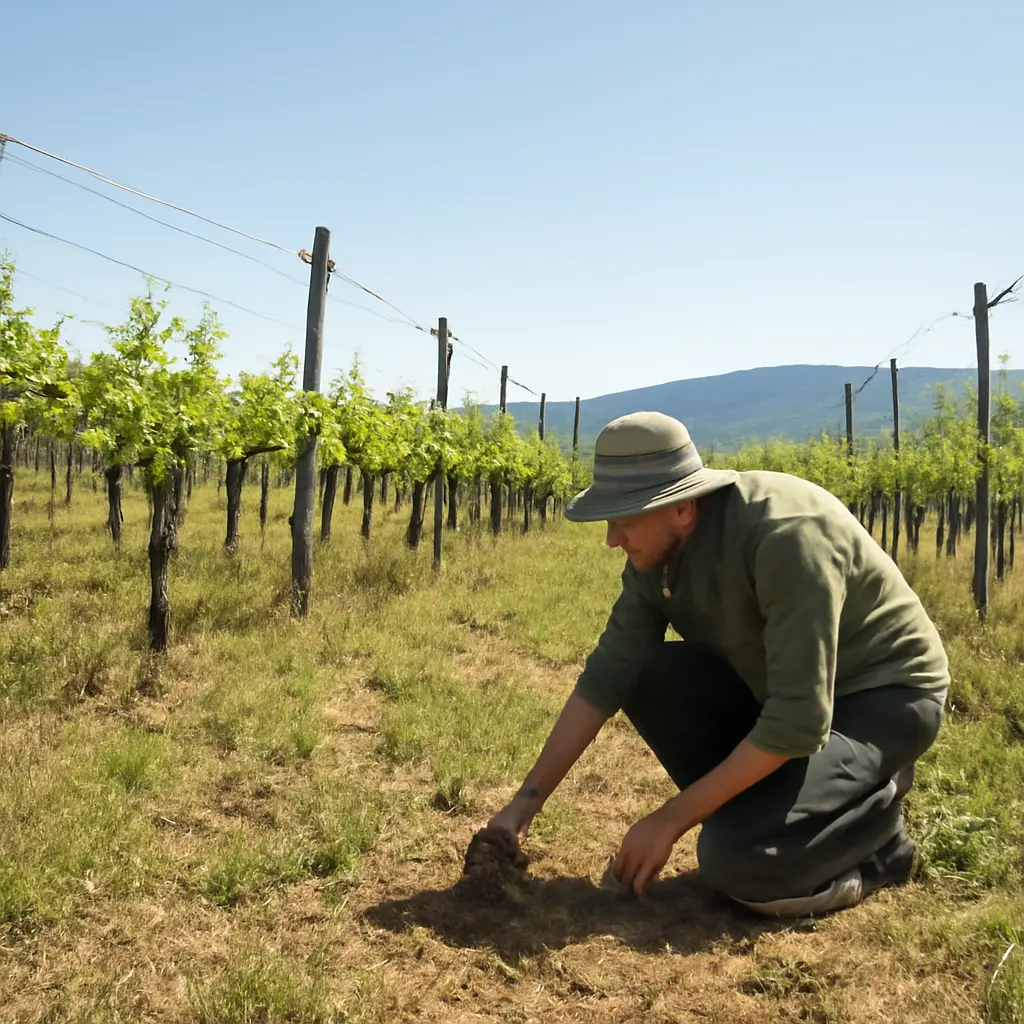
Vineyard soil and slope are the physical conditions that shape how vines access water, nutrients, sunlight, and heat. They do not dictate a wine’s flavor on their own, but research and vineyard practice show that site conditions can influence vine growth and grape composition—often before cellar decisions come into play. Soil depth and water-holding capacity, together with slope, aspect, and elevation, affect those conditions; the results are then filtered through weather, grape variety, rootstock, farming, harvest choices, and winemaking. Understanding those links makes it easier to judge both the power and the limits of claims about terroir.
How vineyard soil and slope shape vine performance
Terroir is commonly used to describe the interaction of a vineyard’s natural setting and human decisions. The International Organisation of Vine and Wine (OIV) treats it as a concept involving identifiable physical and biological features of a place, alongside practices that give agricultural products their distinctive characteristics. It is not a single soil type, nor a guarantee that a particular site will taste a certain way.
For vines, soil matters most through properties such as texture, depth, drainage, fertility, and available water. Slope contributes by changing exposure to sunlight, air movement, runoff, erosion risk, and the ease of farming. These factors interact: a shallow, stony soil on a steep, sunny slope can behave very differently from a deep soil on a gentle, cool-facing slope, even within the same region.
Soil as a root environment
Vineyard soil is the rooting environment that stores and supplies water and mineral nutrients while providing physical support. Its influence depends less on a rock name alone than on measurable properties such as soil depth, texture, structure, organic matter, and drainage. A clay-rich profile may retain more water than a coarse sandy or gravelly one, while a shallow soil over bedrock may restrict root volume. Actual performance also depends on fractures, soil layering, rootstock, and seasonal rainfall.
The Food and Agriculture Organization describes soil texture in terms of the relative proportions of sand, silt, and clay. Those proportions help explain water movement, but they do not by themselves predict vine quality. A well-structured clay soil can drain adequately; a sandy soil can still be drought-prone; and a high-organic-matter profile may behave differently from a compacted soil of similar texture. Soil pits, laboratory tests, and in-season moisture monitoring are therefore more informative than broad labels such as “limestone” or “gravel.”
Slope, aspect, and elevation
Slope is the incline of the land, while aspect is the direction a slope faces. Together with latitude, elevation, and local topography, they affect the amount and timing of solar radiation vines receive. In the Northern Hemisphere, south-facing slopes generally receive more direct sunlight than north-facing slopes, though cloud cover, row orientation, nearby hills, and local wind can alter the pattern. Slopes can also encourage cold air to drain downhill, reducing frost exposure in some settings, but valleys and enclosed terrain can still trap cold air.
A steeper slope can improve surface drainage and expose vines to sunlight, but it can also increase runoff, erosion, and labor costs. The Food and Agriculture Organization identifies soil erosion as a major land-degradation concern worldwide, making ground cover, careful traffic management, and terrace maintenance important in sloping vineyards. Slope is therefore not automatically an advantage: its value depends on soil stability, water availability, climate, and the capacity to farm safely.
How soil and slope influence grapes—and where their influence ends
The pathway from site to wine runs through the vine. Soil and topography affect water status, temperature, and vine vigor; those in turn can influence canopy growth, fruit exposure, ripening rate, and grape composition. But the relationship is indirect. The same site can produce different outcomes under different seasons, varieties, rootstocks, crop loads, irrigation regimes, or harvest dates.
Water availability and vine vigor
Plant-available water is the portion of soil water roots can access. When water is plentiful, vines may produce vigorous shoots and dense canopies; when water is limited, shoot growth can slow and berries may remain smaller. Moderate water limitation at particular growth stages can be useful in some wine-grape systems, but severe or prolonged stress can impair photosynthesis, delay ripening, damage vines, and reduce yields. The response varies by cultivar, rootstock, soil profile, and timing.
This is why the claim that “poor soil makes better wine” is too simple. Low fertility or restricted water can restrain excessive vigor, but a site that is too dry or nutrient-deficient may produce unbalanced fruit or an uneconomic crop. Conversely, a deep, fertile soil can support excellent grapes if canopy size and water supply are managed appropriately. Vineyard measurements—such as soil moisture, shoot growth, canopy density, and berry development—are more useful than assuming that stress is inherently beneficial.
Temperature, exposure, and ripening
Slope and aspect can alter the energy vines receive, while elevation and cold-air movement can affect local temperatures. These differences may shift the timing of budbreak, flowering, and harvest, and can change the balance of sugars, acids, color compounds, and aroma precursors in grapes. The direction and size of those effects are site-specific: a warmer exposure may help fruit ripen in a cool climate but increase heat stress in a hot one.
The Intergovernmental Panel on Climate Change has documented rising temperatures and increasing risks from heat and drought in many wine-growing regions. This makes site features more consequential but not necessarily more predictable. A slope that once offered dependable warmth may face excessive heat, while a cooler aspect or higher elevation may become more attractive. Growers increasingly assess exposure, water access, and heat extremes alongside traditional soil classifications.
From grape composition to wine character
Grape composition is the bridge between vineyard conditions and the finished wine. Sugar, acidity, phenolic compounds, and aroma precursors respond to variety, ripeness, canopy conditions, water status, disease pressure, and harvest timing. Soil and slope can influence these variables through their effects on the vine, but they do not transmit a simple “soil flavor” directly into the glass.
Winemaking then adds another layer: fermentation temperature, yeast, extraction, blending, vessel choice, and aging can emphasize or soften differences among lots. This is why vineyard origin should be understood as a set of conditions and tendencies, not a flavor formula. A producer may preserve site contrasts through separate fermentations, or deliberately blend fruit from different exposures and soil profiles for consistency.
How vineyard examples test terroir claims
Real-world vineyard practice shows that soil and slope matter most when they are described precisely and compared carefully. Regional reputation alone cannot establish causation. Stronger evidence comes from measurements across seasons, mapped variation within a vineyard, and comparisons that account for grape variety, farming, and cellar methods.
Burgundy and the idea of climats
Burgundy’s “climats” are specifically delimited vineyard parcels associated with local histories, exposures, and growing conditions. UNESCO’s World Heritage description emphasizes the long-standing relationship between the region’s landscape, vineyard plots, and wine culture. The example illustrates how small differences in position and site can become central to a region’s identity, but it does not prove that geology alone creates a particular taste. Parcel boundaries also reflect centuries of observation, ownership, and practice.
Hillside vineyards and erosion management
Hillside vineyards in regions such as the Mosel demonstrate the trade-offs of steep terrain: strong sun exposure and distinctive local climates come with difficult access, higher labor demands, and erosion risk. Terraces, vegetation between rows, and drainage planning can help protect soil, though the suitable approach depends on slope stability and rainfall. The example reinforces a central point: slope is both a growing condition and a management challenge.
How to assess a vineyard site without relying on slogans
A practical site assessment combines maps, field observation, and repeated measurements. Rather than asking whether a soil is “good,” growers and buyers can ask what the soil allows the vine to do, under which weather conditions, and with what management. The following checklist helps turn broad terroir claims into testable questions:
- Map soil depth, texture, drainage, compaction, and changes across the block.
- Record slope, aspect, elevation, row orientation, and exposure to prevailing winds.
- Monitor soil moisture, vine vigor, canopy density, and crop development over multiple seasons.
- Check erosion, runoff, and access risks, especially on steep or bare ground.
- Compare fruit from different zones while keeping grape variety, harvest timing, and winemaking as consistent as possible.
A chart of soil moisture and vine growth through the growing season, overlaid with slope position and harvest dates, can make these relationships easier to see. Such a graph should be interpreted cautiously: one vintage may be unusual, and correlation between a site zone and a wine characteristic does not prove that one soil component caused it.
Conclusion: soil and slope matter, but they do not make wine alone
Vineyard soil defines the root environment, while slope, aspect, and elevation help shape water movement, sunlight, temperature, and erosion. Those conditions can influence vine vigor and grape development, but their effects are mediated by climate, variety, rootstock, farming, harvest decisions, and winemaking. Burgundy’s climats and steep hillside vineyards show why site matters; soil science and climate research explain why its influence is conditional rather than mystical.
For growers, the useful next step is to measure site variation and manage it deliberately. For wine drinkers, the better question is not whether soil or the winemaker matters more, but how a particular place’s conditions were translated into the grapes and the wine. Further reading from the OIV, FAO, IPCC, and UNESCO can help distinguish documented site effects from marketing shorthand.
Sources: International Organisation of Vine and Wine, Resolution OIV-VITI 333-2010, Definition of Vitivinicultural Terroir, https://www.oiv.int/standards/resolutions-of-the-oiv/viticulture-resolutions; Food and Agriculture Organization of the United Nations, The Importance of Soil Organic Matter, https://www.fao.org/3/a0100e/a0100e00.htm; Food and Agriculture Organization of the United Nations, Soil Erosion: The Greatest Challenge to Sustainable Soil Management, https://www.fao.org/3/i6874e/i6874e.pdf; Intergovernmental Panel on Climate Change, Climate Change 2022: Impacts, Adaptation and Vulnerability, https://www.ipcc.ch/report/ar6/wg2/; UNESCO World Heritage Centre, Climats, terroirs of Burgundy, https://whc.unesco.org/en/list/1425/