
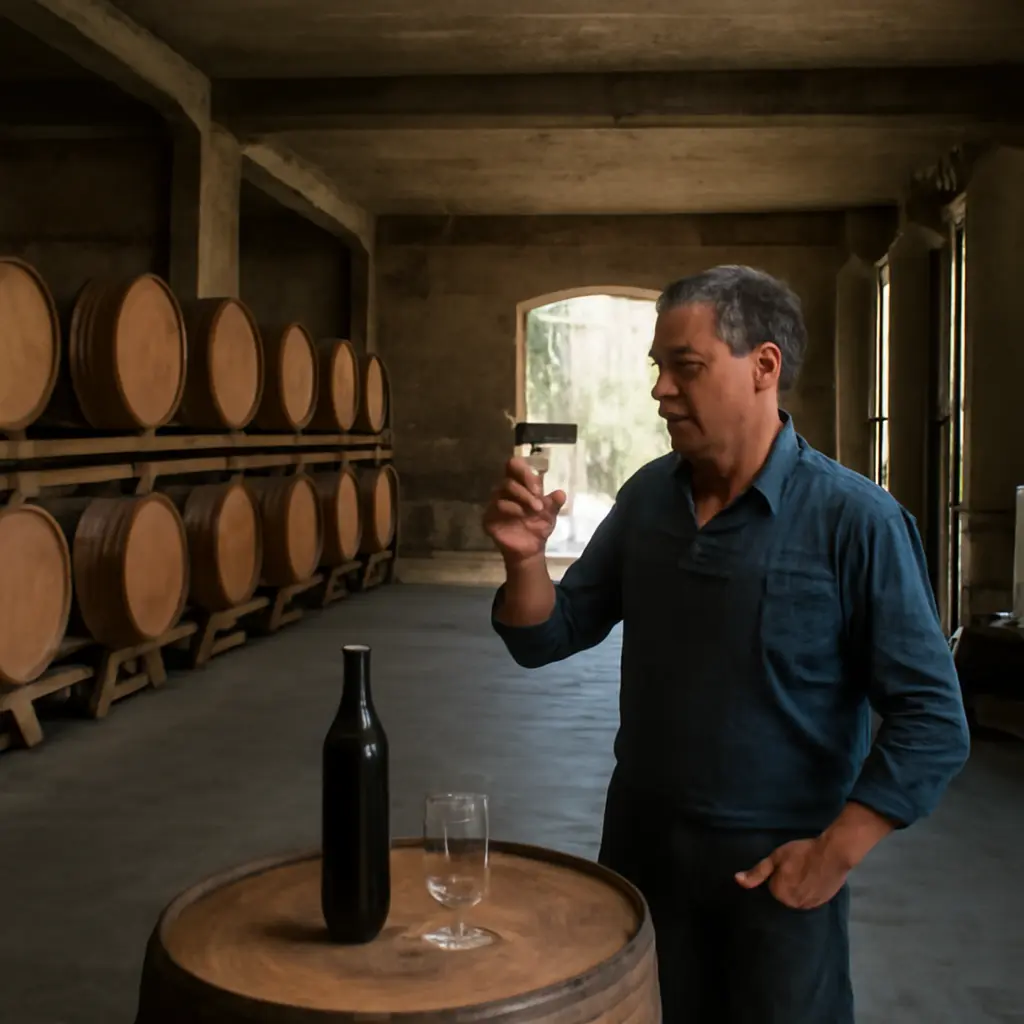
Wine acidity is the collection of acids that give wine freshness, shape, and balance. The amount that remains after fermentation and winemaking is not always obvious from a tasting note—or from a single acidity number: a producer may adjust acidity, encourage malolactic fermentation, or leave some natural acidity intact. “How much acid winemakers leave behind” therefore has no universal answer. It depends on the grape, wine style, pH, titratable acidity, and cellar choices. Understanding those measures helps explain why a crisp Riesling, a rounded Chardonnay, and a high-acid sparkling wine can taste so different, even when their numbers do not tell the whole story.
Winemaking choices determine how much wine acidity remains
In technical terms, wine acidity is not one ingredient with one fixed quantity. It refers to a group of acids and their effects on a wine’s chemical balance and sensory character. The International Organisation of Vine and Wine (OIV) sets analytical methods for measuring acidity, while the University of California, Davis, wine-science program explains how acid composition, pH, and buffering affect wine. The two measures most often used to describe acidity—titratable acidity and pH—answer different questions.
A key distinction is that winemakers do not generally “remove all the acid” or leave a standard amount. They make style and stability decisions within the rules of their region. Some acidity is naturally present in grapes; more can be added, and some can be reduced by biological or physical processes. The resulting figures vary by grape variety, harvest conditions, fermentation, and intended style, so a single universal “amount left behind” would be misleading.
Titratable acidity: the amount of neutralizable acid
Titratable acidity (TA) measures the amount of acid that can be neutralized in a sample by a base to a specified endpoint. It is commonly reported in grams per liter, expressed as tartaric acid equivalents in many wine-producing regions. TA is useful for assessing a wine’s overall acid load and its likely sourness, but it does not identify every acid separately or fully predict how acidic the wine will taste.
As a broad style illustration—not a legal or universal target—many dry table wines fall around 5–8 g/L TA, while some notably crisp wines sit higher and some softer styles lower. The range varies with region, grape, and reporting convention. A wine’s sweetness, alcohol, tannin, aroma, and temperature also affect the perception of acidity. That is why a number should be interpreted alongside the wine’s style rather than treated as a complete tasting verdict.
pH: acid strength and chemical conditions
pH measures hydrogen-ion activity on a logarithmic scale; it is not another way of stating TA. A lower pH usually means a more acidic chemical environment, but two wines with the same pH can have different TA because their acid concentration and buffering differ. In practical terms, pH is especially important to microbial stability, sulfur-dioxide effectiveness, color, and some aspects of taste.
A difference of one pH unit represents a tenfold difference in hydrogen-ion activity, which is why small numerical shifts can matter in the cellar. Winemakers commonly monitor both pH and TA rather than relying on either alone. A wine can have relatively high TA yet a less strikingly low pH, or a low pH without an exceptionally high TA, depending on its composition.
The main acids: tartaric, malic, and lactic
Tartaric and malic acids are major grape-derived acids. Tartaric acid is the principal acid in most wines and is relatively resistant to microbial breakdown. Malic acid is also present in grapes, with levels affected by variety and ripeness; it often contributes a sharp, green-apple-like impression. During malolactic fermentation, lactic-acid bacteria convert malic acid into lactic acid and carbon dioxide. Lactic acid is less sharp in taste, so the process commonly softens a wine’s acidity even though it does not simply make every acidity measurement disappear.
Other acids, including citric, succinic, and acetic acids, may occur in smaller amounts or arise during fermentation and aging. Their effects differ. For example, acetic acid is associated with volatile acidity and, at excessive levels, an undesirable vinegar-like character. This is one reason “total acid” is an incomplete description of what a drinker senses.
Winemakers manage wine acidity through distinct cellar choices
Once the measures are clear, the next question is what winemakers do to change or preserve them. The main approaches include biological acid reduction, chemical adjustment, and choices that influence how acidity is perceived. These options are not interchangeable: malolactic fermentation changes acid composition, while acid addition raises acidity, and blending can alter balance without using the same intervention.
Malolactic fermentation: changing sharp malic acid to softer lactic acid
Malolactic fermentation, often abbreviated MLF, is a bacterial conversion of malic acid to lactic acid. It is commonly encouraged in many red wines and in some white wines, including styles of Chardonnay, to reduce a sharper impression and contribute a rounder texture. It may also produce buttery aromas through diacetyl, though that character depends on production choices and is not an inevitable result.
MLF is not universal. Winemakers may block it in wines where they want to retain a fresh, fruit-forward profile, or manage it carefully to meet a particular style. Its effect on pH and TA depends on wine composition and conditions; it should not be summarized as a fixed reduction in grams per liter. The practical lesson is that a wine can retain substantial acidity while tasting less sharp after its acid profile changes.
Acid addition and deacidification: correcting a wine’s balance
When grapes are very ripe or grown in warm conditions, acidity may be lower than desired. Depending on local regulations and the wine’s needs, producers can add permitted acids—often tartaric acid—to improve balance and support stability. Conversely, if a wine is excessively acidic, cellar practices such as blending or authorized deacidification may be considered. The permitted methods and limits vary by jurisdiction, so practices cannot be generalized across all wine regions.
These adjustments are normally guided by analysis and tasting, not by a single universal target. A cellar team may test a small sample, compare possible additions or blends, and evaluate the result before treating a larger lot. The goal is typically balance and soundness, not the maximum or minimum possible acid level.
Residual sugar and serving conditions: why acidity can seem hidden
Residual sugar is the sugar remaining after fermentation. It does not erase acidity, but sweetness can mask or counterbalance its sharpness. This is why a sweet wine can still be lively when its acidity is high, while a dry wine with similar acidity may seem more austere. Alcohol, dissolved carbon dioxide, tannins, and serving temperature also influence how the palate experiences the same measured acidity.
Sparkling wines provide a clear example of this interaction: carbon dioxide adds a prickling sensation, while dosage—the wine and sugar mixture added during finishing—can affect perceived balance. Comparing a wine’s sweetness and serving style with its TA and pH gives a more useful picture than assuming acidity alone determines whether it tastes “sharp.”
Wine acidity varies with grape, climate, and intended style
Cellar choices begin with the fruit. Grape variety, vineyard temperature, harvest timing, and vintage conditions shape the starting acid profile, so the same winemaking method can yield different results from different grapes or growing seasons. This variation explains why producers may discuss style rather than disclose a single amount of acid “left behind.”
Climate and harvest timing change the starting point
As grapes ripen, sugar generally increases while malic acid tends to decline through respiration; the pace and extent depend on climate, variety, and vineyard conditions. Cooler growing conditions often help grapes retain acidity, while warm conditions can accelerate malic-acid loss. This is a broad tendency, not a guarantee: site, water availability, crop load, and seasonal weather also matter.
Harvest decisions involve trade-offs. Picking earlier may preserve freshness but can produce less-ripe flavors, while later picking may give riper fruit and more sugar but lower natural acidity. Producers assess flavor development and analytical measurements together. The starting acid concentration in the grapes is therefore a major reason finished wines differ even before cellar choices are made.
Examples across wine styles
A cool-climate Riesling may preserve pronounced acidity and balance it with residual sugar; a red wine may undergo MLF and still retain a fresh structure; and a Chardonnay may be made with or without MLF depending on the intended style. Sparkling wines often depend on acidity for freshness and aging potential, but the final balance also reflects blending and dosage. These are examples of stylistic choices, not fixed rules for every bottle bearing those grape or style names.
A useful visual for readers would be a two-axis chart plotting pH against TA for representative wines, with labels for style and sweetness. Such a chart would show why pH and TA should not be treated as the same measurement, while also making clear that sensory balance depends on more than either axis alone.
What drinkers can—and cannot—learn from acidity figures
Acidity figures can help compare wines when producers provide consistent measurements, but they cannot reveal every cellar choice or predict taste on their own. A bottle’s technical sheet may list pH, TA, residual sugar, or whether malolactic fermentation occurred. Those details offer context; they are not a universal quality score, and many labels do not provide them.
- Look for the measurement type. A TA figure and a pH figure describe different properties and use different scales.
- Check sweetness and style. Residual sugar and wine style can change how acidity is perceived.
- Ask about malolactic fermentation. It can explain a softer impression, especially in some whites and reds, but does not mean the wine contains no acidity.
- Compare like with like. Measurements are most meaningful when wines share a similar style, region, and reporting convention.
The broader implication is that acidity is both a sensory feature and a winemaking tool. Producers may not volunteer a single “acid left behind” number because there is no single number that captures acid composition, balance, and perception. For a more transparent comparison, readers can consult technical sheets and ask wineries whether reported acidity is TA, pH, or both.
Conclusion: wine acidity is managed, not simply left behind
Wine acidity is shaped by grape chemistry, climate, and cellar practice. Titratable acidity describes neutralizable acid, while pH describes hydrogen-ion activity; neither alone predicts the full taste. Malolactic fermentation changes the acid profile, additions and deacidification can adjust balance where permitted, and sweetness and serving conditions affect perception. Rather than looking for a hidden universal figure, compare measurements in context and ask producers how they define them. Technical sheets and wine-science resources are good places to continue learning.
Sources: International Organisation of Vine and Wine (OIV), Compendium of International Methods of Wine and Must Analysis, https://www.oiv.int/standards/compendium-of-international-methods-of-wine-and-must-analysis; University of California, Davis, Department of Viticulture and Enology, Wine Chemistry, https://wineserver.ucdavis.edu/industry-info/enology; Jackson, Ronald S., Wine Science: Principles and Applications, 5th ed., Academic Press, 2020, https://www.sciencedirect.com/book/9780128165379/wine-science