
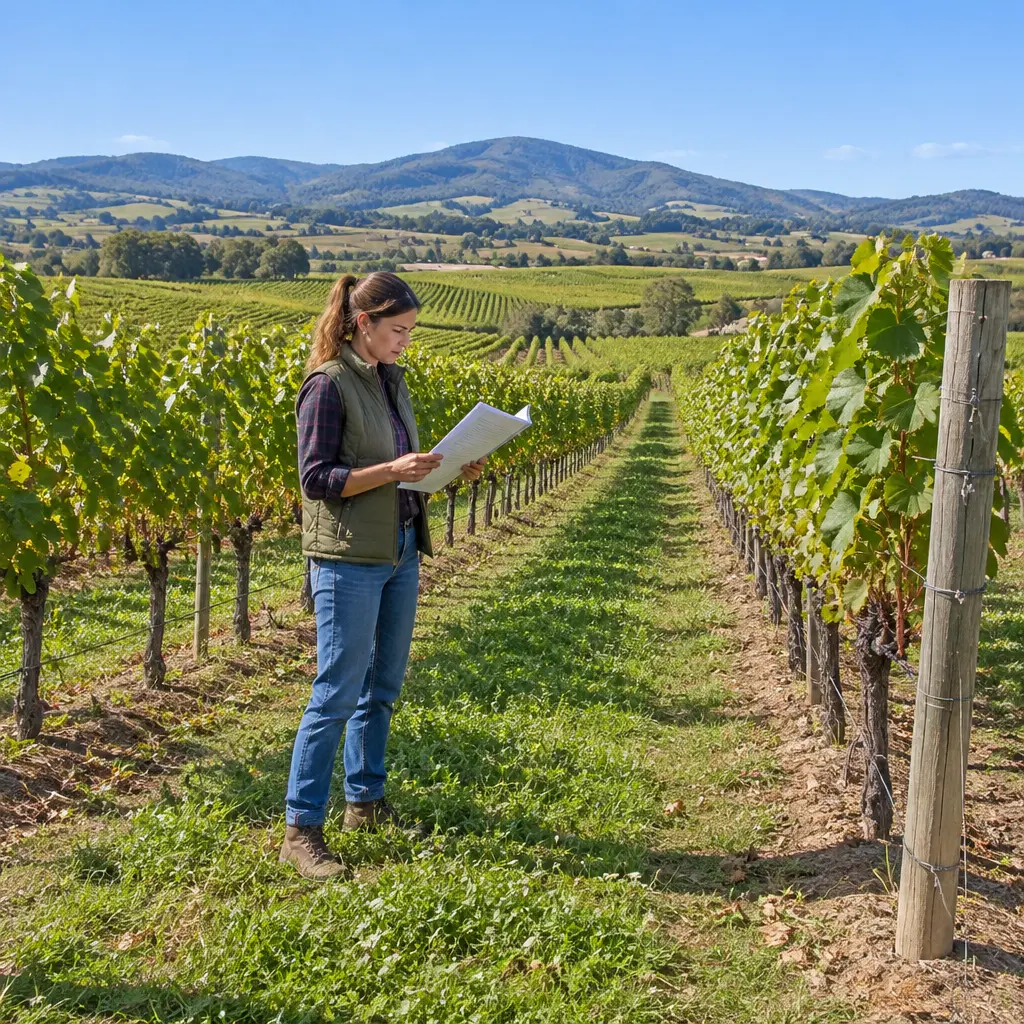
Organic wine certification is a regulated claim about how grapes are grown and, in some jurisdictions, how wine is made; biodynamic certification adds a separate set of farm-management requirements that must be verified rather than inferred from labels or marketing. The distinction matters as organic agriculture expands: the Research Institute of Organic Agriculture (FiBL) and IFOAM–Organics International reported 96.4 million hectares of organic agricultural land worldwide in 2022, though that figure covers all organic farming, not vineyards alone. To assess a bottle credibly, consumers should distinguish organic rules from biodynamic standards, check the certifier and current certificate, understand what inspections and records establish, and treat broader claims about soil vitality or wine quality as claims requiring their own evidence.
Organic wine certification defines production claims, not every farming practice
“Organic wine” can refer to certified organic grape production and, depending on the legal regime and label wording, restrictions on winemaking inputs and processes. The precise meaning is jurisdiction-specific. In the United States, the U.S. Department of Agriculture’s National Organic Program distinguishes “organic wine” from “wine made with organic grapes.” In the European Union, organic production and labeling are governed by EU organic legislation, including rules for wine production. A label should therefore be read in the context of the market where the wine is sold, not assumed to represent one universal standard.
Organic certification generally verifies compliance with defined rules through an accredited or recognized certifier, documentation, and inspection. It is not, by itself, proof that a vineyard follows biodynamic principles, uses no permitted substances, produces wine with a particular taste, or delivers a measurable climate benefit. Those are separate questions that require separate standards or evidence.
Organic grapes and organic wine are different label claims
Under U.S. Department of Agriculture rules, wine labeled “organic” must use organically produced ingredients and meet applicable restrictions on processing and additives. A wine labeled “made with organic grapes” must use organic grapes but may follow a different set of production requirements; sulfites, for example, are not permitted in U.S. wine labeled “organic,” while limited sulfite use may be allowed for wine made with organic grapes. The National Organic Program’s labeling categories and the product’s certification status should be checked directly, because front-label language alone can be easy to misread.
Certification is an auditable process
Certification is a formal assessment against a published standard, not a general endorsement of a producer’s values. In the USDA system, certified operations maintain records and undergo inspections; certification decisions are made by accredited certifying agents. The European Commission likewise describes organic control as involving checks on operators and their records. These systems make traceability—linking vineyard, harvest, cellar inputs, and finished product—central to substantiating the claim.
Biodynamic certification verifies a distinct farm-management standard
Biodynamic certification is a private-standard claim layered on top of, but not synonymous with, organic certification. Demeter International describes biodynamic agriculture as a holistic approach that treats the farm as an interconnected organism and sets requirements for matters such as farm biodiversity, soil care, livestock integration where feasible, and the use of specified preparations. Demeter’s standards are the basis for its certification program; other organizations may use different standards, so “biodynamic” should always be tied to a named certifier and current rulebook.
The key verification question is not whether a grower uses biodynamic language, but whether the relevant vineyard and winery are certified under a recognizable standard and whether the certificate covers the product and production stage being claimed. Biodynamic methods can include practices also found in organic agriculture, but the two categories are not interchangeable: organic certification does not establish biodynamic compliance, and biodynamic claims should not be treated as a substitute for checking the underlying organic and wine-label rules.
Demeter certification and its scope
Demeter International’s standards apply to biodynamic farm production and, through separate processing requirements, to products made from certified ingredients. Certification scope matters: a certificate might cover a farm, a winery, a particular product, or a defined period. Consumers and buyers should verify the named legal operator, product category, certification status, and validity dates rather than relying on a producer’s general statement that the estate is biodynamic.
Biodynamic preparations and calendar practices
Biodynamic farming is associated with preparations—such as compost preparations and field sprays—and, for some practitioners, timing farm work with lunar or other astronomical calendars. A certification audit can verify whether required practices and records meet the standard; it cannot, by that fact alone, prove every proposed mechanism or outcome associated with those practices. Scientific assessment should distinguish the verifiable practice from claims about its effects, such as improved soil biology, flavor, or vineyard resilience.
Certification evidence separates verified practice from marketing language
Reliable verification combines the label, the certifier’s public records, and production documentation. A logo is useful only when it can be matched to a real certification and the correct product or operator. For a trade buyer, importer, or conscientious consumer, the strongest evidence is a current certificate plus a clear chain of custody from certified grapes through bottling.
Check the certifier, certificate, and product scope
Start with the name of the certifier shown on the bottle or producer’s documentation. Confirm that the certifier is recognized for the applicable scheme, then check whether the certificate is current and covers the vineyard, winery, and specific wine. In the United States, the USDA Organic Integrity Database can be used to search certified operations. For biodynamic wine, consult the relevant organization’s certification directory or request the certificate from the producer. A farm’s certification should not automatically be assumed to extend to every wine it sells, especially where fruit is purchased from outside growers.
Trace inputs, harvests, and cellar records
Inspection records and transaction documents help show that certified grapes were not mixed with non-certified fruit and that cellar materials complied with the applicable standard. Useful records include grower and parcel details, harvest weights, receiving logs, batch and blending records, input invoices, cleaning procedures, and bottling records. Organic and biodynamic standards differ in what they require, but traceability is the practical link between a field-level claim and the bottle in a consumer’s hand.
Ask what “natural,” “low-intervention,” and “sustainable” mean
Terms such as “natural,” “low-intervention,” and “sustainable” do not automatically mean certified organic or biodynamic. Their definitions and verification vary by scheme and jurisdiction. A producer may use low-intervention cellar methods while not holding organic certification, or may be certified organic without being biodynamic. Ask for the standard, certifier, and scope behind each claim, and distinguish audited requirements from voluntary descriptions.
Organic and biodynamic metrics need careful interpretation
Global organic-area statistics provide context for the growth of certified agriculture, but they do not demonstrate how much wine is certified or whether certification improves a specific environmental outcome. FiBL and IFOAM reported 96.4 million hectares of organic agricultural land in 2022, an increase of 26.6 percent from 2021, with Australia accounting for the largest national area. These totals include all agricultural sectors. They should not be presented as vineyard acreage or as evidence that biodynamic wine has a particular market share.
For wine, meaningful comparisons require vineyard-specific and outcome-specific data: pesticide-use records, soil organic matter measured over time, erosion rates, water use, biodiversity indicators, or greenhouse-gas accounting with a stated boundary. Certification can establish adherence to a standard, while outcome studies are needed to test whether a practice produces a particular ecological result under particular conditions. Likewise, claims that biodynamic wine tastes better require appropriately designed sensory research, not certification status alone.
Certification is not a guarantee of a specific environmental result
A standard establishes minimum requirements and a method for checking compliance; environmental outcomes can still vary with climate, soil, site, management, and measurement choices. Organic rules restrict specified substances and practices, but a consumer should not infer that every certified vineyard has identical biodiversity, water, or emissions performance. Biodynamic standards add management requirements, yet their certification likewise should not be converted into an unqualified claim of superior environmental performance without comparative data.
A practical comparison chart for readers
A useful comparison chart would place “USDA organic,” “EU organic,” “Demeter biodynamic,” and “uncertified producer claim” in separate columns, then compare governing standard, certifier, inspection or control process, label scope, and public certificate lookup. The chart should avoid ranking systems as universally “better”; it should show what each claim verifies and where its boundaries lie. For a specific bottle, record the exact label wording, certifier, certificate number if available, validity period, and whether the certificate covers grapes, winemaking, or both.
Real-world verification begins with the bottle and ends with records
Consider two wines whose producers both describe their farms as biodynamic. One bottle carries a current Demeter mark and can be matched to a certificate covering the vineyard and wine processing; the other relies only on the producer’s website description. The first provides independently checkable evidence of compliance with a named standard. The second may still come from a grower using biodynamic practices, but the claim has not been independently substantiated by that certification. This distinction is about evidence, not a judgment of either wine’s quality.
For a retailer or restaurant, a practical due-diligence file can include a bottle-label photograph, the certificate and expiration date, the certifier’s lookup result, the producer’s explanation of purchased fruit, and the applicable organic labeling category. Consumers can use a shorter version: identify the exact claim, find the certifier, confirm the certificate’s scope and date, and ask the producer what the certification covers. When the answer is vague or the certificate cannot be verified, treat the wording as a marketing claim rather than proof of certification.
Conclusion: verify the standard behind the story
Organic wine certification and biodynamic certification answer related but different questions. Organic rules establish legally defined production and labeling requirements; biodynamic certification verifies additional practices under a named private standard. Strong verification depends on checking the certifier, current certificate, product scope, and traceability records—not simply trusting evocative terms on a label. Global organic acreage data show the scale of organic agriculture, but they cannot establish vineyard-specific outcomes or prove that one farming system produces better wine. Buyers and consumers should ask for the standard and evidence behind each claim, and consult certifier databases and current regulations before drawing conclusions.
Sources: U.S. Department of Agriculture, National Organic Program: Organic Labeling, https://www.ams.usda.gov/rules-regulations/organic/labeling; U.S. Department of Agriculture, Organic Integrity Database, https://organic.ams.usda.gov/Integrity/; European Commission, Organic farming: legislation, https://agriculture.ec.europa.eu/farming/organic-farming/legislation_en; Demeter International, Standards, https://demeter.net/certification/standards/; FiBL and IFOAM–Organics International, The World of Organic Agriculture: Statistics and Emerging Trends 2024, https://www.fibl.org/en/shop-en/1747-organic-world-2024