
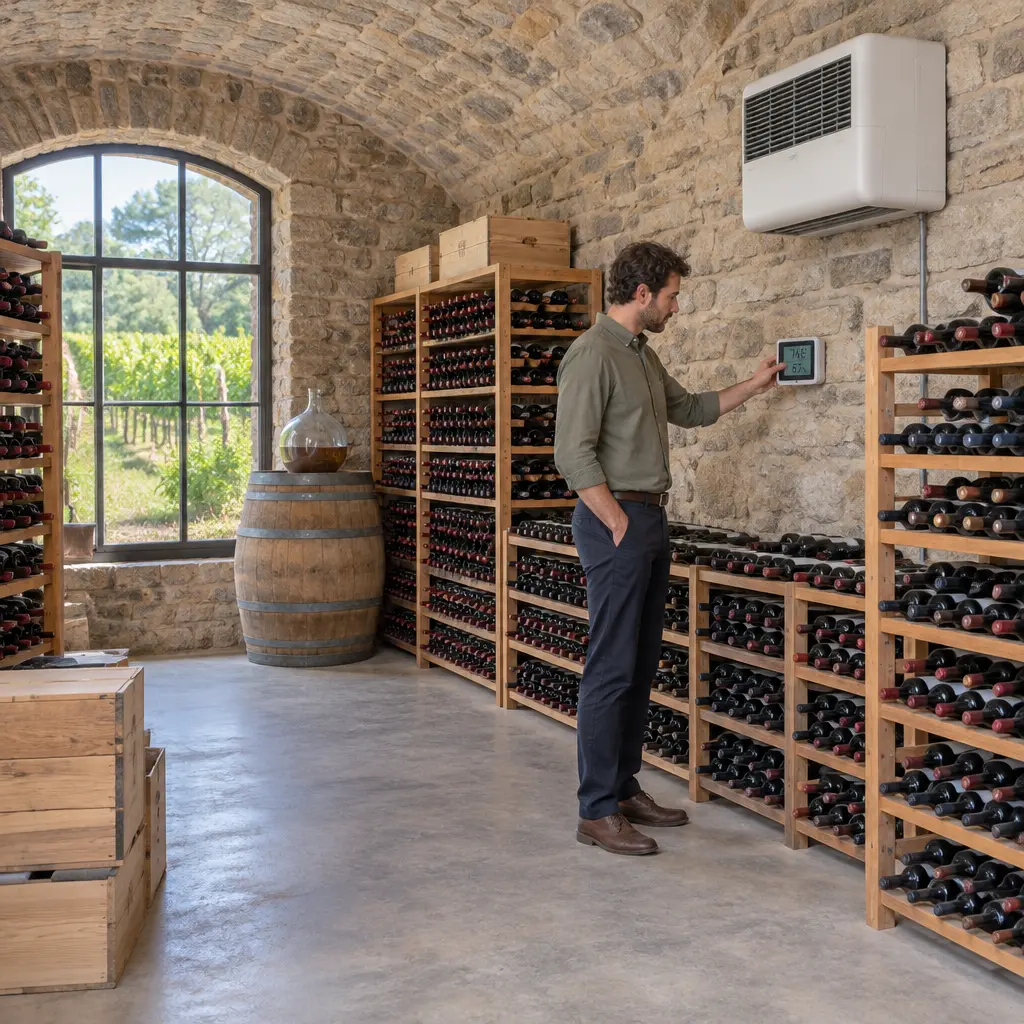
A wine cellar’s humidity is the amount of water vapor in its air, usually expressed as relative humidity (RH). Keeping cellar RH reasonably steady—often around 60–70%—helps limit cork shrinkage and the risk of a dried, poorly sealing cork, while also protecting labels and packaging. Humidity is only one part of storage: temperature stability, bottle position, airflow, and avoiding condensation matter too. The guidance below explains the humidity target, how to measure and control it, and how to avoid overcorrecting; it also distinguishes cork preservation from claims that humidity directly improves wine.
Cellar humidity and cork preservation
Relative humidity compares the water vapor in air with the maximum the air could hold at the same temperature. The American Society of Heating, Refrigerating and Air-Conditioning Engineers (ASHRAE) defines relative humidity in relation to the saturation vapor pressure at a given temperature. For wine storage, this measurement describes the cellar environment, not the moisture content inside a cork or bottle.
Many wine-storage guides recommend roughly 60–70% RH, with some allowing a broader range near 50–70%. These are practical operating ranges, not a universally proven threshold at which corks suddenly fail. A natural cork’s principal seal is maintained by its compression against the bottle neck; prolonged dry conditions may contribute to cork shrinkage or loss of elasticity, but wine closures vary and cellar humidity alone does not predict leakage. The Wine Spectator and wine-storage specialists commonly emphasize moderate humidity alongside a stable temperature, often around 55°F (13°C).
Why corks need a stable environment
Natural cork is a cellular material harvested from cork oak bark. It is compressed during bottling and expands against the inside of the neck to form a seal. The Cork Quality Council describes cork as a natural, elastic closure, while wine-science research recognizes that oxygen transfer varies among closures and individual bottles. Humidity is relevant because extremely dry ambient conditions may encourage drying of exposed cork surfaces over time, but the liquid-facing side of a properly sealed cork is also in contact with wine.
The familiar advice to store bottles on their sides is principally intended to keep wine in contact with a natural cork. It is not a substitute for managing cellar RH, and it does not apply in the same way to screw caps or many synthetic closures. A steady cellar environment reduces avoidable stress, but no humidity setting can guarantee that every cork will remain sound.
Humidity ranges and the limits of the evidence
A practical target is approximately 60–70% RH, measured where the bottles are stored. A cellar that stays near 50% may still store wine successfully, particularly when temperature is stable and bottles are properly sealed; persistent readings below that range can justify checking for drafts or excessive drying. Readings consistently above 70–75% increase the likelihood of mold on labels, cartons, and cellar surfaces, especially where air circulation is poor. These ranges are operational guidance rather than a guarantee of cork performance.
Temperature stability is at least as important as a precise humidity number. The Wine Institute and major wine-storage references commonly place long-term storage near 55°F, while also warning against heat and repeated temperature swings. A cellar that is cool and stable but a little outside a preferred RH range is generally a better environment than one that repeatedly warms, cools, or condenses moisture.
Monitoring cellar humidity consistently
Consistent humidity means keeping readings within a reasonable band over time, not chasing a single exact percentage. Since RH changes with air temperature, a measurement should be interpreted alongside temperature and the location of the sensor. A small digital hygrometer can reveal daily and seasonal patterns; a recording device or data logger is useful when a cellar has valuable long-term inventory.
Choosing and placing a hygrometer
A hygrometer measures relative humidity. Place it near the stored bottles, away from a humidifier outlet, exterior door, cooling unit, or direct airflow, because those locations may not represent conditions throughout the cellar. In a large or irregular room, compare readings in more than one area. Check the instrument periodically against a second device or a calibration method recommended by its manufacturer; inexpensive sensors can drift.
Record readings at a consistent time and note temperature, weather, and any changes to the cellar system. A simple chart can show whether a low reading is persistent or merely a short-lived response to a temperature change. For example, if RH falls after a cooling unit runs but returns to its usual range, adding water immediately may create unnecessary dampness.
Finding causes before adjusting humidity
Low RH can result from dry outdoor air entering through gaps, excessive ventilation, heating, or a cooling system that removes moisture. High RH can stem from water intrusion, poor drainage, a persistent leak, or insufficient air movement. Inspect the cellar envelope and equipment before adding a humidifier or dehumidifier. Fixing a leak or sealing an unintended draft is usually more reliable than treating the symptom with another appliance.
A cellar’s temperature and humidity interact: when air cools, its capacity to hold water vapor decreases, so RH can rise even if the amount of water vapor has not changed. Conversely, heating air without adding moisture can lower RH. This is why tracking both measurements is more useful than treating a hygrometer reading in isolation.
Controlling humidity without causing cellar damage
Humidity control means correcting persistent conditions with appropriately sized equipment and sound building maintenance. The goal is a stable, clean cellar—not the highest possible RH. Mold, condensation, corrosion, and damage to labels or wood can become problems when a cellar is kept too damp.
Managing a dry cellar
If readings remain below the desired range, first investigate drafts, heating, and the cellar cooling system. A room-sized humidifier with a humidistat can help when the cause cannot be corrected through maintenance, but it should be sized for the space and cleaned according to its manufacturer’s instructions. Avoid placing open water containers or wet materials near bottles: they offer little control and may encourage microbial growth or pests.
Increase humidity gradually and verify the result with a separate hygrometer. Do not direct mist or warm humidifier exhaust at bottles, walls, or electrical equipment. If the cellar is a wine refrigerator rather than a room, follow the appliance maker’s guidance; some units are designed to manage humidity differently from a conventional cellar.
Managing a damp cellar
When RH stays high, identify moisture sources and improve drainage or ventilation where appropriate. A dehumidifier may be warranted, but excessive operation can dry the room and cause sharp fluctuations. Keep air moving gently, maintain equipment, and inspect walls, racks, cartons, and labels for condensation or mold. The U.S. Environmental Protection Agency identifies moisture control as a central measure for limiting indoor mold growth; visible mold or recurring dampness should be addressed at its source rather than covered up.
Some surface aging or mustiness in an old cellar does not prove that wine has been harmed, but active mold and persistent condensation signal that the environment needs attention. Protect labels and cardboard packaging, which can be more vulnerable to dampness than the bottle itself. Do not use aggressive chemicals near open wine or cellar materials without checking safety instructions.
Bottle position and closure type
For bottles sealed with natural cork, horizontal storage is a common precaution because it keeps wine against the cork. Synthetic corks and screw caps do not require the same liquid-to-cork contact, though they still benefit from stable, cool storage. Champagne and other sparkling wines also require secure storage appropriate to their closure and bottle design. Follow the producer’s recommendations when available, and avoid repeatedly moving bottles while trying to optimize their position.
Applying humidity guidance to real cellars
A small domestic cellar and a commercial wine-storage facility have different humidity-control needs. A homeowner may rely on a calibrated hygrometer and seasonal checks; a professional facility may use monitored climate systems, alarms, and documented maintenance. In both cases, the useful measure is the pattern over time, paired with temperature and inspection of the bottles and room.
Example: seasonal RH swings
Suppose a cellar reads 58% RH in winter and 68% in summer while holding a stable temperature. Those readings are close to commonly recommended storage conditions and may not justify equipment changes. If winter readings instead fall persistently below 40%, the owner should check for heating and air leaks, verify the sensor, and then consider controlled humidification. If summer readings repeatedly exceed 75% with wet walls or mold, the priority is finding moisture intrusion and improving moisture management.
A practical monitoring routine
- Measure RH and temperature near the bottles, not only beside the cellar door or cooling unit.
- Record readings regularly for several weeks to distinguish persistent conditions from short-term fluctuations.
- Inspect for dry drafts, leaks, condensation, mold, and changes to corks or labels.
- Correct building or equipment problems before adding humidity-control devices.
- Recheck readings after any adjustment and maintain appliances as directed.
A chart with date, temperature, RH, and observations is often more useful than a single “ideal” reading. For a large collection, a data logger with alerts can help identify overnight or seasonal swings that a once-a-week check might miss.
Conclusion: maintain stable humidity, not a perfect number
Cellar humidity is a meaningful part of wine storage because prolonged dryness may contribute to cork problems, while excessive dampness can damage labels and encourage mold. A practical target near 60–70% RH, paired with cool, stable temperature, is a useful starting point—not a universal guarantee. Measure conditions where the bottles are, verify trends, investigate the cause of persistent extremes, and make gradual adjustments. For valuable collections, consult a wine-storage professional or the cellar-equipment manufacturer before substantial changes.
Sources: ASHRAE, ASHRAE Handbook—Fundamentals, https://www.ashrae.org/technical-resources/ashrae-handbook; Wine Spectator, How to Store Wine, https://www.winespectator.com/articles/how-to-store-wine-47794; Cork Quality Council, Cork and Wine Closures, https://www.corkqc.com/; Waterhouse, A. L., Sacks, G. L., and Jeffery, D. W., Understanding Wine Chemistry, Wiley, https://www.wiley.com/en-us/Understanding+Wine+Chemistry-p-9781118627808; U.S. Environmental Protection Agency, Mold: Basic Facts, https://www.epa.gov/mold/mold-basics