
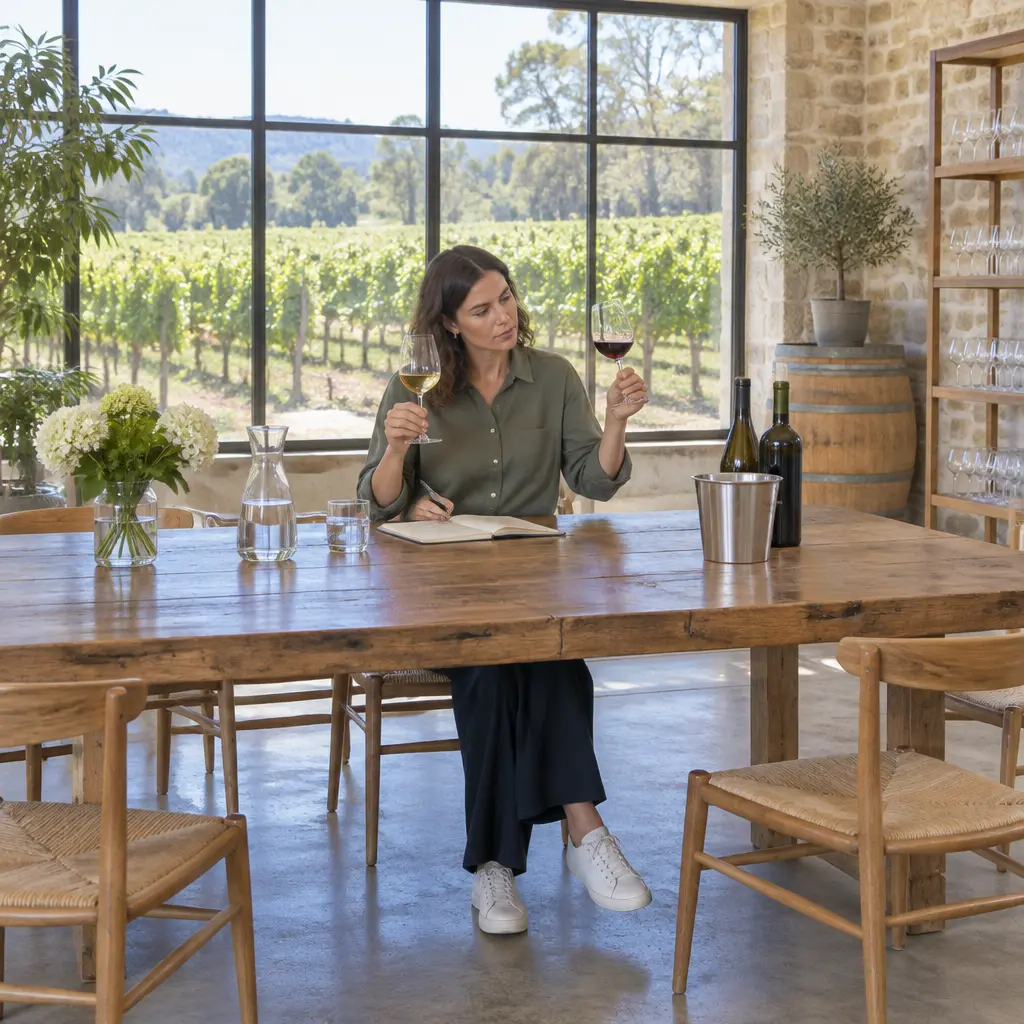
Wine-tasting vocabulary is the set of words used to describe a wine’s appearance, aromas, flavors, texture, and overall balance. Developing it is less about memorizing impressive adjectives than learning to notice, compare, and name sensory evidence consistently. A structured routine—observe, smell, taste, record, and compare—helps beginners move from broad impressions such as “fruity” or “smooth” to clearer descriptions such as “ripe black cherry, medium acidity, and a drying tannic finish.” This guide explains how tasting language works, how to practise it without relying on guesswork, and how to use tasting grids and comparison exercises to make descriptions more precise.
Structured wine tasting develops descriptive vocabulary
A tasting description is a concise account of sensory observations, not a test of whether someone can identify a wine’s exact grape, region, or price. The Court of Master Sommeliers and the Wine & Spirit Education Trust (WSET) both teach systematic approaches that separate observation from interpretation. Their methods commonly move through appearance, nose, palate, and conclusion, giving tasters a repeatable sequence for noticing detail.
A structured sequence matters because smell and taste are closely connected, while attention and memory can be inconsistent. The National Institute on Deafness and Other Communication Disorders notes that much of what people experience as flavor comes from smell. There is no single universal statistic that measures how quickly a person acquires wine vocabulary; progress depends on practice, sensory experience, and familiarity with the language. A practical measure is whether a taster can give a specific, evidence-based description and explain which observation supports each term.
The main vocabulary groups are appearance terms, aroma and flavor families, structural terms such as acidity and tannin, and evaluative terms such as balance and length. Learning them in this order helps prevent a common mistake: jumping to a judgment like “excellent” before identifying what is actually in the glass.
Observation defines the wine-tasting vocabulary framework
A wine-tasting framework is an organized set of sensory categories and prompts for describing wine. WSET’s Systematic Approach to Tasting (SAT) is one prominent example: it guides tasters through appearance, nose, palate, and conclusions so that observations can be recorded in a consistent order. The framework does not make every taster use identical words; it helps them notice comparable features and distinguish sensory evidence from personal preference.
Within this framework, useful descriptive terms fall into related groups: appearance, aroma and flavor, palate structure, and overall assessment. These categories connect naturally: appearance begins the inspection, aroma suggests what to seek on the palate, and structural observations help explain the wine’s final impression.
Appearance terms describe observable visual features
Appearance vocabulary covers color, intensity, clarity, and, where relevant, bubbles or viscosity. A taster might record “pale lemon,” “medium ruby,” or “deep garnet” rather than simply “light” or “dark.” Color can offer clues about grape variety, age, or winemaking, but it cannot establish those facts on its own. Lighting, glass shape, and the wine’s condition can also affect what the eye perceives.
For practice, describe the wine before trying to identify it. Note the color family and intensity, then move on. This keeps visual observation separate from assumptions such as “deep color means powerful,” which may not be true for every wine.
Aroma and flavor terms name sensory families
Aroma refers to what is smelled, while flavor describes the combined impression perceived while tasting, including retronasal aromas released as air passes from the mouth toward the nose. Descriptors are often grouped into families: fruit, flowers, herbs, spices, earth, and aromas associated with fermentation or maturation. For example, “red fruit” can be refined to “fresh strawberry,” while “spice” might become “black pepper” or “clove.”
Use the most specific term that feels defensible, not the most elaborate one available. If a wine suggests citrus but the exact fruit is unclear, “citrus” is a sound observation. Aroma wheels and reference sets can help connect familiar smells to vocabulary, but they are prompts rather than answer keys: tasters may perceive different associations in the same wine.
Palate structure terms describe how wine feels
Palate structure refers to physical and taste-related features such as sweetness, acidity, tannin, alcohol, body, and carbonation. Acidity is commonly described through its mouthwatering or crisp impression; tannin can create a drying or gripping sensation, especially in red wines. Body describes perceived weight, while alcohol may contribute warmth. These terms explain a wine’s shape and texture rather than naming its fruit.
Precise comparisons are more useful than vague rankings. Instead of writing “high acidity,” a beginner can compare two wines and note that one feels “more mouthwatering.” Instead of calling a wine “heavy,” record that it feels “full-bodied” or “richer in texture,” if those observations fit. The terms are related but not interchangeable: a full-bodied wine is not necessarily high in tannin or alcohol.
Balance and finish connect observations to an assessment
Balance describes how a wine’s components—including fruit, acidity, sweetness, tannin, alcohol, and oak—work together. Finish refers to the impression that remains after swallowing or spitting. A taster can describe a finish as short, moderate, or long, then note whether it remains fruity, savory, bitter, or otherwise distinctive.
These terms are most useful when supported by observations. “Balanced” is stronger when the taster can explain that the acidity keeps ripe fruit from seeming heavy, or that firm tannin is matched by concentrated fruit. Similarly, “long finish” should describe a lasting sensory impression, not just a general opinion that the wine was enjoyable.
Structured practice strengthens descriptive accuracy
Vocabulary develops through repeated attention and retrieval: notice a feature, find a suitable word, record it, and revisit the observation. A brief tasting note is valuable because it forces the taster to turn an immediate impression into language. Comparing wines side by side adds context, making differences in acidity, body, aroma, or finish easier to recognize than when each wine is tasted in isolation.
A useful session can be completed with two or three wines and a consistent tasting order. The aim is not to produce the longest note, but to make each note more specific and better supported than the last.
Use a repeatable tasting sequence
A repeatable sequence reduces the chance that a strong first impression will dominate the whole assessment. The following routine adapts common professional tasting frameworks for home practice:
- Look at the wine and record its color family, intensity, and clarity.
- Smell before swirling, then smell again after swirling; list broad aroma families before choosing specific descriptors.
- Taste a small sip and assess sweetness, acidity, tannin, body, alcohol warmth, and flavor intensity.
- After swallowing or spitting, record the finish and any flavors or textures that persist.
- Write a short conclusion that summarizes the strongest evidence without guessing the wine’s identity.
Spitting is a normal part of professional tasting and helps tasters remain attentive when sampling multiple wines. It is also sensible to taste responsibly, use small pours, and avoid driving after drinking.
Build a personal aroma reference set
A personal reference set links words to recognizable smells. Smell everyday items such as lemon peel, crushed herbs, berries, black pepper, or dried flowers, and record the qualities that distinguish them. This practice helps a learner understand what “citrus,” “herbal,” or “spicy” means in their own sensory memory instead of treating descriptors as vocabulary to memorize by rote.
Reference materials should be used thoughtfully. A scent kit or aroma wheel can suggest categories, but real foods and spices offer familiar comparisons at low cost. Keep notes about uncertainty as well as confidence: “possible dried cherry” is more honest and useful than stating an exact aroma as fact when the evidence is ambiguous.
Compare wines and revise tasting notes
Side-by-side comparison is a practical way to make relative differences visible. Two Sauvignon Blancs, for example, may differ in citrus intensity, herbal character, body, or acidity. Rather than asking which is “better,” identify how they differ and which observations support that comparison. A blind tasting can reduce the influence of labels and prices, although it does not guarantee correct identification.
After the tasting, revisit notes and replace broad words with more informative ones where the evidence allows. “Nice fruit” might become “fresh pear and lemon”; “smooth” might be clarified as “low tannin with a soft texture.” Keep the original note if useful, then add the revised version so that improvement is visible over time.
Common vocabulary errors obscure useful observations
Wine language becomes clearer when tasters distinguish what they sense from what they infer. Aroma, structure, and quality judgments can overlap in casual conversation, but separating them makes tasting notes more reproducible and easier for another reader to understand.
Avoid treating preferences as sensory facts
“I like this wine” is a valid preference, but it does not describe a sensory feature. A fuller note can include both: “I like it because the bright acidity balances the ripe peach flavor.” This wording preserves personal response while identifying the qualities that prompted it.
Do not confuse aroma with flavor or structure
Aroma and flavor describe smell-related impressions; acidity, tannin, and body describe other aspects of the palate. Calling a wine “acidic” because it smells like lemon confuses a citrus aroma with a structural sensation. A better note records both separately, such as “lemon aroma; crisp acidity.”
Use specific descriptors without overstating certainty
Specificity is valuable only when it reflects what the taster can actually perceive. If several fruits seem plausible, choose a broader category or list two possibilities. Sensory vocabulary is inherently personal, and the same wine can evoke different memories; the goal is consistent, understandable description, not perfect agreement among tasters.
Conclusion: structured practice makes wine language useful
Developing wine-tasting vocabulary means learning to observe appearance, identify aroma and flavor families, describe palate structure, and support conclusions about balance and finish. A consistent tasting sequence, personal aroma references, and side-by-side comparisons turn abstract terms into practical tools. The broader benefit is not simply more elaborate notes: clearer language helps people communicate preferences, compare wines thoughtfully, and learn from each tasting. Choose two wines, use the same sequence for both, and write one evidence-based note for each; over time, review and refine the words that best describe what you actually perceive.
Sources: Wine & Spirit Education Trust, “The WSET Level 2 Systematic Approach to Tasting Wine,” https://www.wsetglobal.com/knowledge-centre/wset-systematic-approach-to-tasting; Court of Master Sommeliers, Americas, “Deductive Tasting Method,” https://www.mastersommeliers.org/certification/deductive-tasting-method; National Institute on Deafness and Other Communication Disorders, “Taste Disorders,” https://www.nidcd.nih.gov/health/taste-disorders.